E-flat major
 | |
| Relative key | C minor |
|---|---|
| Parallel key | E♭ minor (enharmonic: D♯ minor) |
| Dominant key | B♭ major |
| Subdominant | A♭ major |
| Component pitches | |
E♭, F, G, A♭, B♭, C, D | |
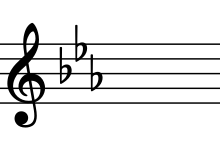
E-flat major (or the key of E-flat) is a major scale based on E♭, with the pitches E♭, F, G, A♭, B♭, C, and D. Its key signature has three flats: B, E, and A. Its relative minor is C minor, while its parallel minor is E♭ minor (or enharmonically D♯ minor).
The E-flat major scale is:

Contents
1 Characteristics
2 Well-known compositions in this key
3 Notes
4 External links
Characteristics
The key of E-flat major is often associated with bold, heroic music, in part because of Beethoven's usage. His Eroica Symphony, Emperor Concerto and Grand Sonata are all in this key. Also Beethoven's (hypothetical) 10th symphony is in the key of E-flat major. But even before Beethoven, Francesco Galeazzi identified E-flat major as "a heroic key, extremely majestic, grave and serious: in all these features it is superior to that of C."[1]
Three of Mozart's completed horn concertos and Joseph Haydn's famous Trumpet Concerto are in E-flat major and so is Anton Bruckner's Fourth Symphony with its prominent horn theme in the first movement. Another famous heroic piece in the key of E-flat major is Richard Strauss's A Hero's Life. The heroic theme from the Jupiter movement of Holst's The Planets is in E-flat major. Mahler's vast and heroic Eighth Symphony is in E-flat and his Second Symphony also ends in the key.
This is not to say that, in the Classical period, E-flat major was only for bombastic music with brass. "E-flat was the key [Joseph] Haydn chose most often for [string] quartets, ten times in all, and in every other case he wrote the slow movement in the dominant, B-flat."[2] Or "when composing church music and operatic music in E-flat major, [Joseph] Haydn often substituted cors anglais for oboes in this period", and also in the Symphony No. 22 in E-flat major.[3]
For Mozart, E-flat major was associated with Freemasonry, "E-flat evoked stateliness and an almost religious character."[4]
Well-known compositions in this key
Johann Sebastian Bach
- Cello Suite No. 4, BWV 1010
- Prelude & Fugue in E-flat major "St. Anne", BWV 552
Ludwig van Beethoven
- Septet for Strings and Woodwinds, Op. 20
- Symphony No. 3, Op. 55 "Eroica"
- Piano Concerto No. 5, Op. 73 "Emperor"
- Piano Sonata No. 4, Op. 7 "Grand Sonata"
- Piano Sonata No. 18, Op. 31/3 "The Hunt"
- Piano Sonata No. 26, Op. 81a "Les Adieux"
- String Quartet No. 10, Op. 74
- String Quartet No. 12, Op. 127
Max Bruch
Scottish Fantasy in E-flat major, Op. 46
Anton Bruckner
- Symphony No. 4, WAB 104 "Romantic"
Frédéric Chopin
- Nocturne in E-flat, Op. 9 No. 2
- Etude in E-flat, Op. 10 No. 11 "Arpeggio"
- Grande valse brillante, Op. 18
Andante spianato et grande polonaise brillante, Op. 22- Prelude in E-flat, Op. 28 No. 19 "Heartfelt Happiness"
- Nocturne in E-flat, Op. 55 No. 2
Charles-Valentin Alkan
- Prelude Op. 31 No. 7 "Librement mais sans secousses"
- Etude Op. 35 No. 7 "L'incendie au village voisin"
Antonín Dvořák
- String Quartet Op. 51
Joseph Haydn
- String Quartet Op. 33 No. 2, "The Joke"
- Symphony No. 22, Hob.I:22 "Philosopher"
- Symphony No. 103, Hob.I:103 "Drumroll"
- Trumpet Concerto, Hob.VIIe:1
Franz Liszt
- Piano Concerto No. 1, S.124
- Transcendental Étude No. 7 "Eroica"
Gustav Mahler
- Symphony No. 8, "The Symphony of a Thousand"
Felix Mendelssohn
- Octet, Op. 20
Wolfgang Amadeus Mozart
- Piano Concerto No. 9, K. 271 "Jeunehomme"
- Piano Concerto No. 10 for two pianos, K. 365/316a
- Quintet for Piano and Winds, K. 452
- Piano Concerto No. 22, K. 482
- Sinfonia Concertante for violin and viola, K. 364/320d
- Symphony No. 39, K. 543
Franz Schubert
- Impromptu in E-flat, Op. 90 No. 2
- Piano Trio No. 2 (Schubert)
Robert Schumann
- Symphony No. 3, Op. 97 "Rhenish"
Dmitri Shostakovich
- Cello Concerto No. 1, Op. 107
- Symphony No. 9, Op. 70
Jean Sibelius
- Symphony No. 5, Op. 82
John Philip Sousa
- The Stars and Stripes Forever
Pyotr Ilyich Tchaikovsky
- 1812 Overture, Op. 49
Notes
^ Francesco Galeazzi, Elementi teorico-practici di musica (1796) as translated to English in Rita Steblin, A History of Key Characteristics in the Eighteenth and Early Nineteenth Centuries. University of Rochester Press (1996): 111
^ Paul Griffiths, The String Quartet. New York: Thames & Hudson (1983): 29
^ David Wyn Jones, "The Symphonies of Haydn" in A Guide to the Symphony, ed. Robert Layton. Oxford: Oxford University Press
^ Robert Harris, What to Listen for in Mozart. Simon & Schuster (2002): 174
External links
 Media related to E-flat major at Wikimedia Commons
 Media related to E-flat major at Wikimedia Commons
Diatonic scales and keys | |||||||||||||||||||||||||||||||||||||||||||||||||||||||
|---|---|---|---|---|---|---|---|---|---|---|---|---|---|---|---|---|---|---|---|---|---|---|---|---|---|---|---|---|---|---|---|---|---|---|---|---|---|---|---|---|---|---|---|---|---|---|---|---|---|---|---|---|---|---|---|
 |
| ||||||||||||||||||||||||||||||||||||||||||||||||||||||
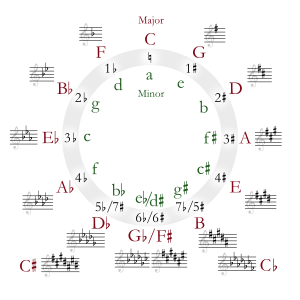
| The table indicates the number of sharps or flats in each scale. Minor scales are written in lower case. | |||||||||||||||||||||||||||||||||||||||||||||||||||||||


