Pupin Hall
Pupin Physics Laboratory, Columbia University | |
U.S. National Register of Historic Places | |
U.S. National Historic Landmark | |
 Pupin Hall | |
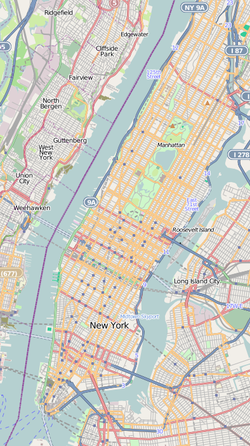  Show map of Manhattan  Show map of New York  Show map of the US | |
| Location | New York, NY |
|---|---|
| Coordinates | 40°48′36.23″N 73°57′41.52″W / 40.8100639°N 73.9615333°W / 40.8100639; -73.9615333Coordinates: 40°48′36.23″N 73°57′41.52″W / 40.8100639°N 73.9615333°W / 40.8100639; -73.9615333 |
| Built | 1925 - 1927[1] |
| Architect | McKim, Mead, and White[1] |
| Architectural style | Renaissance inspired with colonial influence[2] |
| NRHP reference # | 66000550 |
| Significant dates | |
| Added to NRHP | October 15, 1966[3] |
| Designated NHL | December 21, 1965 [4] |
Pupin Physics Laboratories /ˈpjuːpɪn/, also known as Pupin Hall, is home to the physics and astronomy departments of Columbia University in New York City and a National Historic Landmark. It was built in 1925-1927 to provide more space for the Physics Department which had originally been housed in Fayerweather Hall, and named for Serbian physicist Mihajlo Idvorski Pupin, who graduated with honors in 1883 at Columbia College, after his death in 1935. The building is located on the south side of 120th Street, just east of Broadway. It has been named a National Historic Landmark for its association with experiments relating to the splitting of the atom, achieved in connection with the later Manhattan Project.
By 1931, the building which later became Pupin Hall was a leading research center. During this time Harold Urey (Nobel laureate in Chemistry) discovered deuterium and George B. Pegram was investigating the phenomena associated with the newly discovered neutron. In 1938, Enrico Fermi escaped fascist Italy after winning the Nobel prize for his work on induced radioactivity. In fact, he took his wife and children with him to Stockholm and immediately emigrated to New York. Shortly after arriving he began working at Columbia University with Dr. John Dunning. His work on nuclear fission, together with I. I. Rabi's work on atomic and molecular physics, ushered in a golden era of fundamental research at the university. One of the country's first cyclotrons was built in the basement of Pupin Hall by John R. Dunning, where it remained until 2007. The building's historic significance was secured with the first splitting of a uranium atom in the United States, which was achieved by Enrico Fermi in Pupin Hall on January 25, 1939, just 10 days after the world's first such successful experiment, carried out in Copenhagen, Denmark.
Pupin Hall is named after Mihajlo Idvorski Pupin (also known as Michael I. Pupin), a Serbian-American scientist and graduate of Columbia. Returning to the university's engineering school as a faculty member, he played a key role in establishing the department of electrical engineering. Pupin was also a brilliant inventor, developing methods for rapid x-ray photography and the "Pupin coil," a device for increasing the range of long-distance telephones. After his death in 1935, the university trustees named the newly constructed physics building the "Pupin Physics Laboratories" in his honor.
The building was declared a National Historic Landmark in 1965.[4][5][6] In 2009 the American Physical Society named Pupin Hall a historic site and honored Isidor Isaac Rabi for his work in the field of magnetic resonance.
[7]
Contents
1 Advances in research
2 Features and layout quirks
3 See also
4 References
5 External links
Advances in research
The building is a landmark due to the advances in nuclear research made there during the Manhattan Project to develop the first nuclear weapon. It is connected to the university tunnels, from which one can occasionally access the Manhattan Project's leftover cyclotron and other historic research facilities. Sadly, many of these have been sealed off since the 1980s, when Ken Hechtman wrought havoc with nuclear materials he stole from Pupin's basement.
Other discoveries and breakthroughs achieved in Pupin include:
- The discovery of deuterium by Harold Urey
- The investigation of neutron phenomena by George Pegram
- The construction of one of the country's first cyclotrons
- January 25, 1939: the first splitting of a uranium atom in the United States, by Enrico Fermi
Features and layout quirks
The current main entrance to Pupin is on the 5th floor from the plaza above Dodge Physical Fitness Center. This means that many of the seminar rooms in Pupin on floors 2-4, while above ground, are below campus level and, therefore, windowless. The original entryway was on the first floor from the Grove, but got blocked by the construction of Dodge in the 1960s. The entryway smells like chlorine because Uris Pool has an exit stairway leading into Pupin's entry.
The Rutherfurd Observatory is on top of Pupin. The Astronomy Department hosts bi-monthly Public Observing Nights, and serves the Tri-State area in hosting people interested in observing with an optical telescope.[8]
See also
- Columbia University
- Columbia University Physics Department
- Michael I. Pupin
- I.I. Rabi
- Enrico Fermi
- National Historic Landmarks
References
^ ab Dolkart, Andrew. Morningside Heights: a History of its Architecture & Development. New York : Columbia University Press, 1998. .mw-parser-output cite.citation{font-style:inherit}.mw-parser-output q{quotes:"""""""'""'"}.mw-parser-output code.cs1-code{color:inherit;background:inherit;border:inherit;padding:inherit}.mw-parser-output .cs1-lock-free a{background:url("//upload.wikimedia.org/wikipedia/commons/thumb/6/65/Lock-green.svg/9px-Lock-green.svg.png")no-repeat;background-position:right .1em center}.mw-parser-output .cs1-lock-limited a,.mw-parser-output .cs1-lock-registration a{background:url("//upload.wikimedia.org/wikipedia/commons/thumb/d/d6/Lock-gray-alt-2.svg/9px-Lock-gray-alt-2.svg.png")no-repeat;background-position:right .1em center}.mw-parser-output .cs1-lock-subscription a{background:url("//upload.wikimedia.org/wikipedia/commons/thumb/a/aa/Lock-red-alt-2.svg/9px-Lock-red-alt-2.svg.png")no-repeat;background-position:right .1em center}.mw-parser-output .cs1-subscription,.mw-parser-output .cs1-registration{color:#555}.mw-parser-output .cs1-subscription span,.mw-parser-output .cs1-registration span{border-bottom:1px dotted;cursor:help}.mw-parser-output .cs1-hidden-error{display:none;font-size:100%}.mw-parser-output .cs1-visible-error{font-size:100%}.mw-parser-output .cs1-subscription,.mw-parser-output .cs1-registration,.mw-parser-output .cs1-format{font-size:95%}.mw-parser-output .cs1-kern-left,.mw-parser-output .cs1-kern-wl-left{padding-left:0.2em}.mw-parser-output .cs1-kern-right,.mw-parser-output .cs1-kern-wl-right{padding-right:0.2em}
ISBN 0-231-07850-1. p. 354
^ Dolkart, Andrew. Conversation with Kitty Chibnik, Columbia University, February 25, 2009
^ National Park Service (2007-01-23). "National Register Information System". National Register of Historic Places. National Park Service.
^ ab "Pupin Physics Laboratory, Columbia University". National Historic Landmark summary listing. National Park Service. 2007-09-11. Archived from the original on 2012-10-10.
^ "Pupin Physics Laboratories, Columbia University", March 1978, by Cecil McKithan%5d "National Register of Historic Places Inventory-Nomination" Check|url=value (help). National Park Service. 1983.
^ Pupin Physics Laboratories, Columbia University--Accompanying photos, 1 exterior and 2 interior showing the cylclotron, from 1975.%5d "National Register of Historic Places Inventory-Nomination" Check|url=value (help). National Park Service. 1983.
^ "American Physical Society names Pupin Hall a Historic Site" (Press release). Columbia University. 2009-02-05. Retrieved 2009-02-27.
^ Public Observing Nights
External links
- National Historic Landmarks database
 Media related to Pupin Hall at Wikimedia Commons
 Media related to Pupin Hall at Wikimedia Commons
U.S. National Register of Historic Places in New York | ||
|---|---|---|
| Topics |
|   |
| Lists by county |
| |
| Lists by city |
| |
| Other lists |
| |
| ||
 Category
 List
List National Register of Historic Places Portal